
Booking Q4 2026Start a project
Full Shopify build for a UK watches and bespoke jewellery retailer — from zero digital presence to a multi-channel store with 5,000 SKUs, custom product architecture, and distribution across eBay and Amazon.
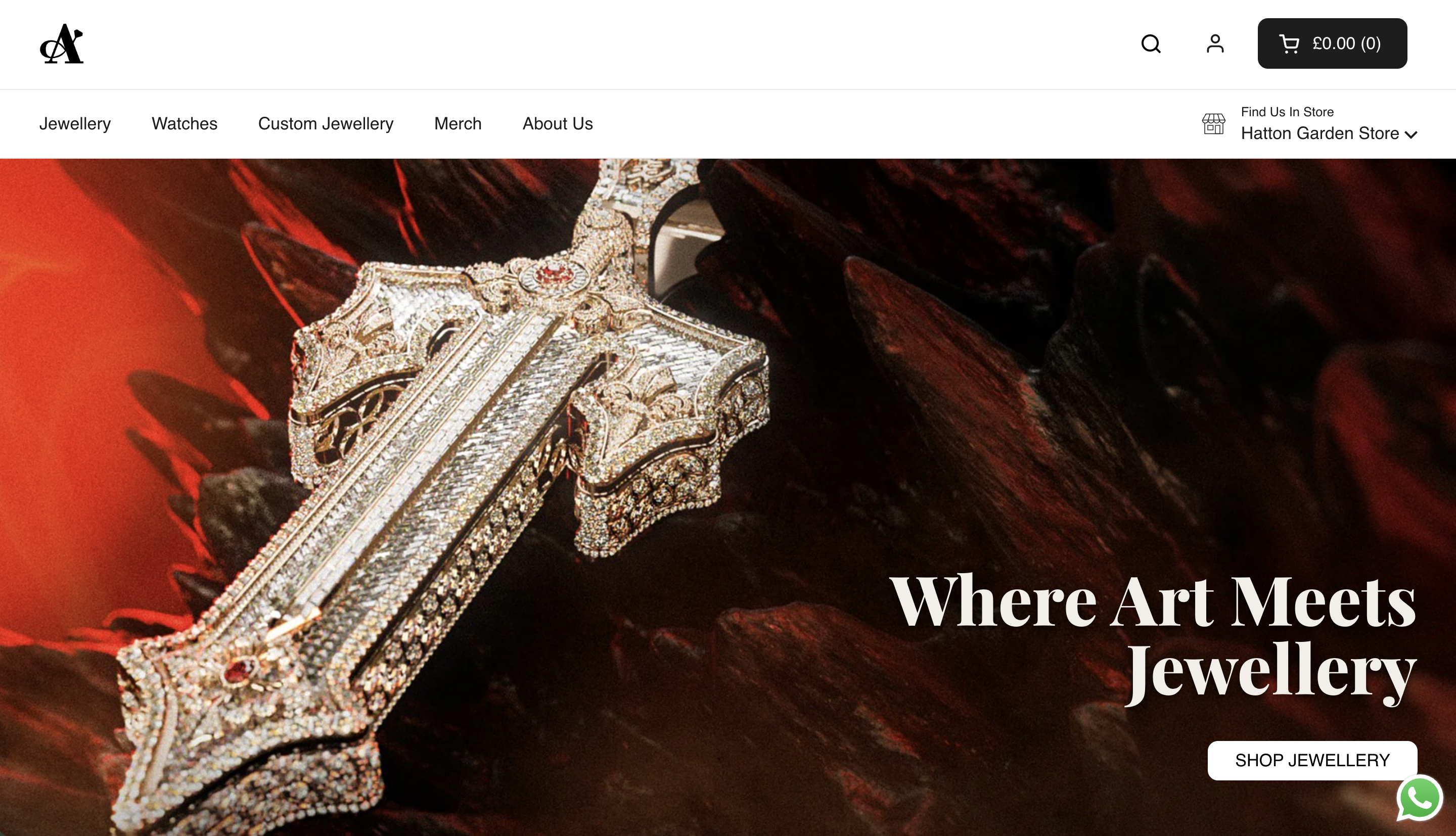
A Jewellers had built a strong reputation through their physical store — expert staff, a curated watch catalogue, and a bespoke jewellery commission service that kept customers coming back. But the business had no digital presence at all. No website. No way to sell online. No visibility beyond the shop floor.
The opportunity was clear: a new revenue arm that could run alongside the physical store without cannibalising it. Online sales for the watch catalogue. Lead generation for bespoke commissions. Marketplace distribution to reach customers who'd never walk past the shop window. And a digital product reference so staff could answer any question about any of 5,000 items instantly, without leaving the counter.
The build needed to:
Off-the-shelf themes couldn't handle the dual nature of the product range — the technical spec depth of a watch catalogue alongside the conversation-driven, relationship-first nature of bespoke jewellery commissions. Everything needed to be purpose-built for how A Jewellers actually sell.
The storefront needed to serve two very different customer journeys in one cohesive experience. A watch buyer arrives with a reference number in mind and needs technical depth — movement type, case dimensions, condition, provenance. A bespoke jewellery customer arrives with an idea and needs to be guided into a conversation, not a cart.
A generic Shopify theme couldn't do both. We built a fully custom Liquid theme from scratch with distinct product page layouts driven by metafield data. Watch pages surface a structured specification panel alongside photography — movement, case, dial, and strap details rendered from metafields, not hard-coded. Bespoke jewellery pages lead with inspiration imagery and materials, then funnel visitors into a commission enquiry flow without leaving the site.
The design language communicates luxury throughout: high-contrast typography, generous whitespace, and photography-first layouts. Navigation is structured around two distinct entry points — browse the watch catalogue, or begin a bespoke conversation. The sales funnel is built into the theme itself, with upsell and cross-sell surfaces woven into the product and cart experience.
Two journeys. One storefront. Built for both.
5,000 SKUs across two product categories with fundamentally different attribute schemas. Shopify's variant system is designed for size and colour combinations — not watch reference numbers, movement calibres, or stone certifications. Metafields were the right tool: structured, queryable, and extensible without compromising the product record.
Two distinct metafield schemas were designed — one for watches, one for bespoke jewellery — each with typed fields, validated values, and namespace separation to keep data clean at scale.
Watch schema:
Brand & catalogue
Brand, model family, and reference number — structured for hierarchical browsing and filtering.
Movement
Type (automatic, quartz, manual wind), calibre, and power reserve.
Case & dial
Case material, diameter, water resistance rating, dial colour, and dial type.
Strap & clasp
Strap or bracelet material, lug width, and clasp type.
Condition
New, pre-owned, or serviced — with service history notes where applicable.
Bespoke jewellery schema:
Metal
Metal type and carat — 18ct yellow gold, 9ct white gold, platinum, sterling silver, and more.
Stones
Primary and secondary stones with cut, carat weight, and certification reference.
Sizing
Ring size, necklace length, bracelet length — where applicable.
Finish
Polished, brushed, hammered, or mixed — surface treatment specification.
Commission status
In stock, made to order, or enquire — this field drives the storefront CTA and determines which purchase flow is shown.
The same metafield data that powers the storefront spec panels is accessible as a staff product reference tool — full product knowledge on any device, in-store.
5,000 products to get into Shopify. A manual upload process — filling in product forms one by one — wasn't viable. We built a custom CSV import application with a structured validation pipeline that handles initial ingestion and ongoing inventory management.
The pipeline runs in stages:
CSV input
Watch or jewellery column template — distinct required fields per category.
Schema mapping
CSV columns are mapped to Shopify product fields and metafield namespaces. Watches and jewellery use separate column templates with distinct required fields — the application knows which schema to apply based on a category field in the CSV.
Validation
Required fields are checked; metafield values are type-validated — numeric fields, enum values for movement type, valid condition codes. Invalid rows are flagged with row number and field-level error context before any write occurs. No partial imports.
Shopify API write
Valid products are created via the Shopify Admin API with metafields attached in the same request. Images are linked by URL and queued for Shopify CDN ingestion.
Status report
Each import run produces a summary: created, skipped, failed — with row-level error details for manual review and correction.
The same pipeline handles ongoing inventory management. Price changes, stock level adjustments, and new product additions all arrive via CSV and flow through the same validation and write process — import once, maintain continuously.
Shopify is the source of truth. eBay and Amazon are distribution channels. A custom integration layer keeps product listings, inventory levels, and orders synchronised across all three — without manual re-entry on any platform.
The integration layer handles four concerns:
Product sync
Shopify product data and metafields are read and mapped to eBay and Amazon listing schemas — which differ significantly in structure, required attributes, and category taxonomy. The mapping layer handles the translation; the source data never needs to be duplicated or reformatted manually.
Category mapping
Shopify product categories are translated to marketplace-specific taxonomies. Watch listings map to the correct eBay category with the required item specifics filled from metafields. Amazon requires ASIN matching or new listing creation with structured attribute sets — both flows are handled.
Inventory sync
Stock level changes in Shopify propagate to eBay and Amazon in real time. A sale on any channel decrements Shopify inventory, and the updated stock count is pushed to the other channels immediately — preventing overselling across the board.
Order routing
Orders placed on eBay and Amazon are ingested and routed into the Shopify order flow. Staff see all orders — regardless of channel — in one place, and fulfilment proceeds through the same Royal Mail workflow.
The team manages products in one system and sells in three. No logging into separate seller dashboards to update listings or check stock.
Email was the primary post-launch revenue mechanism beyond organic search. Six core Klaviyo flows were built, each triggered by a specific customer behaviour rather than scheduled broadcasts — so every email arrives at a meaningful moment in the customer's journey.
Cart abandonment
Triggered 1 hour after a session ends with items in cart. Three-email sequence: a reminder at 1 hour, social proof and product context at 24 hours, and an offer at 72 hours.
Welcome series
Triggered on newsletter signup. Four emails over 10 days introducing the brand, explaining the bespoke jewellery commission process, and showcasing hero products from the watch catalogue.
Post-purchase
Triggered on order fulfilment. Includes order confirmation with item details, a dispatch notification with tracking link, and a 7-day follow-up with care guide and review request.
Delivery updates
Triggered by Royal Mail tracking webhooks. Customers receive a dispatch confirmation and a delivery confirmation automatically — no manual sending, no tracking link to chase.
Bespoke enquiry follow-up
Triggered when a commission enquiry form is submitted from the storefront. An instant acknowledgement is sent to the customer; the full enquiry, with product context, is routed to the jeweller's inbox.
Reactivation
Triggered after 90 days of customer inactivity. A single email with personalised product picks based on past browse and purchase history — brings lapsed customers back without a generic blast.
Royal Mail Click & Drop is integrated to handle the full fulfilment cycle from order creation to delivery confirmation. Orders from the Shopify storefront, eBay, and Amazon all flow through the same process — one unified dispatch workflow regardless of where the sale originated.
The fulfilment loop:
Order created
Shopify order received — directly from the storefront, or routed in from eBay or Amazon via the integration layer.
Picking list generated
Fulfilment task surfaces for staff with item location and full metafield product spec accessible — no separate product lookup needed.
Label printed
Royal Mail Click & Drop generates the shipping label. Parcel is manifested for the next collection.
Royal Mail collection
Parcel collected and tracking number posted back to the Shopify order record automatically.
Customer notified
Klaviyo delivery update flow triggered — dispatch confirmation sent with tracking link. No manual step between label generation and customer notification.
After-sell care
On delivery confirmation, the post-purchase email sequence continues — care guide, review request, and a support touchpoint if anything needs attention.
The result is a closed loop: from the moment an order is placed to the moment the customer receives their care guide, every step is connected — and nothing falls through manually.
Order placed to care guide delivered — fully connected.
All product data, inventory levels, and order management live in Shopify. eBay and Amazon are downstream consumers — the integration layer pushes outward and routes orders back in. Staff manage one system, not three. A sale on any channel decrements Shopify stock, preventing overselling across the board.
Built from scratch — distinct experiences for watch browsing and bespoke commission enquiries
Metafields for brand, family, reference, movement, case, dial, strap, condition, and water resistance
Metafields for metal type, carat, stones, cut, weight, certification, sizing, and commission status
Custom CSV application with schema mapping, validation, and Shopify API batch writes
Listings synced from Shopify, orders routed back via custom integration layer
Product and inventory sync with marketplace-specific category and attribute mapping
Stock levels updated across Shopify, eBay, and Amazon in real time — no overselling
Three-email sequence at 1hr, 24hr, and 72hr via Klaviyo
Four-email onboarding sequence introducing the brand and bespoke process
Order confirmation, tracking link, and 7-day care guide + review request
Royal Mail tracking webhooks trigger dispatch and delivery emails automatically
Commission enquiry → instant customer acknowledgement → jeweller notification
Single personalised email triggered after 90 days of customer inactivity
Click & Drop integration for label generation, manifesting, and tracking
Full metafield data accessible on any device — digital product knowledge base for in-store staff
Discovery to purchase with upsell and cross-sell built into the theme
Whether you need a custom Shopify build, multi-channel marketplace integration, or a product architecture that scales — we'd love to talk.
Start a project